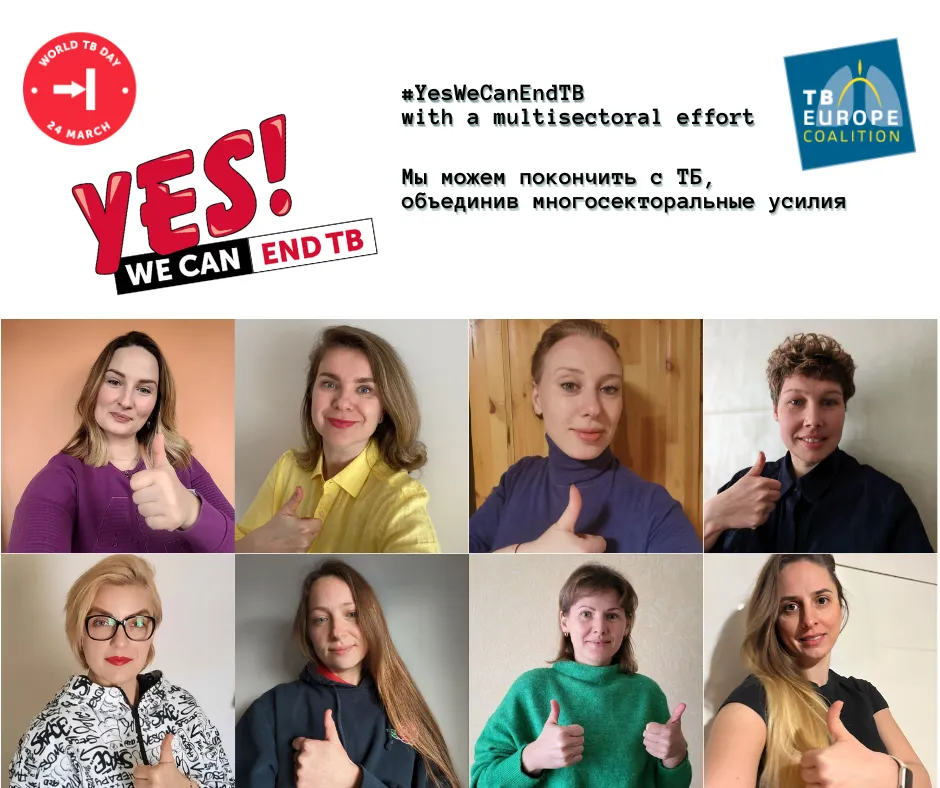
Yes! We can end TB!
On World TB Day, TBEC calls on all stakeholders – national governments, parliamentarians, civil society and TB-affected community representatives, associations, international partners, and donors – to take urgent action and bring together multisectoral and interdisciplinary efforts to end TB.
As WHO Director-General Dr. Tedros Adhanom Ghebreyesus stated during the 2018 United Nations High-Level Meeting on TB: "We must hold each other accountable for the promises we are making today. That’s why we are developing a multisectoral accountability framework with four components: commitment, action, monitoring and review, to ensure we match our talk with real, lasting change."
The Multisectoral Accountability Framework for TB (MAF-TB) developed by WHO is essential for achieving countries’ key goals and milestones to end TB. The initiation and launch of MAF-TB in countries can be carried out both on the basis of existing national platforms (such as the country coordination mechanism or interagency commission) with the introduction of relevant clarifications to by-laws, and on the basis of multisectoral and interdisciplinary structures tailored for the introduction of MAF-TB.
The fundamental idea of MAF-TB links all sectors involved: TB is not a solely medical problem. Along with medical, psychosocial and social care and support needed for effective diagnosis, timely start and favorable completion of therapy, people affected by TB have to tackle problems with obtaining education, employment, movement, living conditions, nutrition, etc.
Contributing to the expansion of comprehensive and integrated people-centered care, MAF-TB will gather all sectors, industries, and partners in achieving national, regional and global targets for the elimination of TB by addressing the biomedical, social and economic drivers of tuberculosis.
Realising that health disparities, especially in TB, derive from socioeconomic determinants of health, we must recognise that ending TB is possible only by means of coordinated multisectoral and interdisciplinary actions of involved partners. These actions should be aimed at creating an effective and transparent system for identifying barriers, facilitating the exchange of experience, finding joint coordinated solutions to overcome those barriers, monitoring progress, increasing the sustainability of efforts to end the TB epidemic and ensuring shared responsibility and accountability by all stakeholders.
The issue of introducing MAF-TB in countries is of particular importance in view of the UN General Assembly High-Level Meeting on Tuberculosis (UN HLM on TB) which will be held this year in September to review the fulfillment of the goals and commitments defined by the 2018 Political Declaration on TB and to outline further clear steps and commitments to end TB by 2030 which should be reflected in a 2023 Political Declaration on TB.
“Being the foundation for countries' political commitment to TB, MAF-TB aims to ensure that the commitments, taken by UN Member States to end TB, are implemented through concrete actions that are tracked, analysed and accounted for. MAF-TB is an approach that promotes coordination, collaboration and mutual accountability both within the health system and throughout multiple sectors and partners in their fight against TB.” - says Paul Sommerfeld, Chair of the TBEC Board. “Therefore, it is critical for civil society organisations and affected communities, as well as all stakeholders in countries, not to miss the opportunities opened up by the 2023 UN HLM on TB, and to build the political will to further expand, launch and implement the Multisectoral Accountability Framework for TB in countries of the WHO European Region”.
#YesWeCanEndTB #WorldTBDay #EndTB